Identification Guide
Background
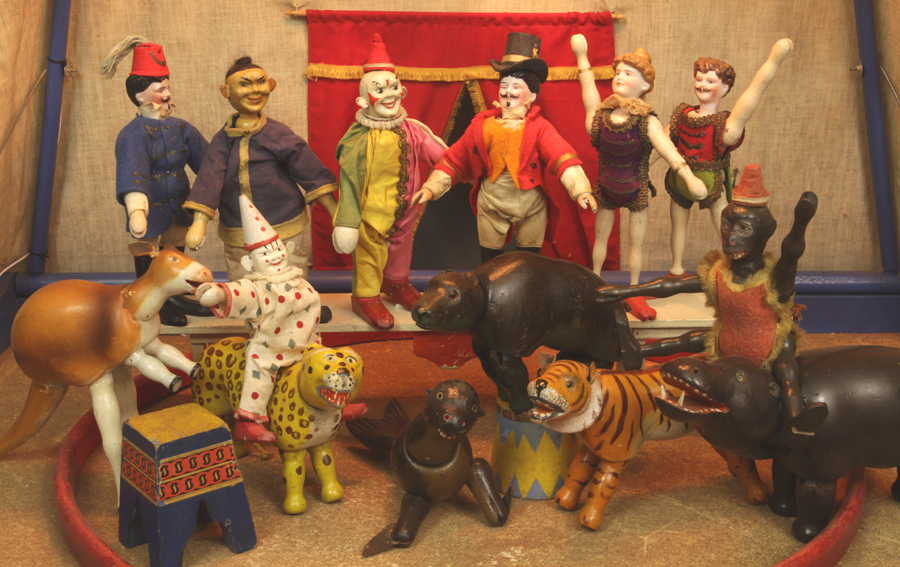
Since the circus was made over a 30-year period of time, many
production design changes emerged making for very interesting collecting possibilities. The major changes occurred when the company was forced
to by world events. WWI, between 1914 and 1918, disrupted the supplies of bisque
heads (probably from France) and glass eyes (probably from Germany). This forced
the company to switch the personnel that used bisque heads (the acrobats, lady
rider, ring master, lion tamer) to painted heads and the glass-eyes animals to painted
eyes. Since painting the eyes was labor intensive, the eyes were gradually simplified
over the years finally to the point that some of the latest eyes were made with
simple eye decals - no painting at all.
In this identification guide, we distinguish between glass eyes, painted eyes, and decal eyes.
Other changes were driven by esthetics, production cost
reduction (two-part heads to one part heads), or material availability including
using the remaining inventory of parts from discontinued items.
Collectors of these toys have different interests. Some will
want only the early glass eyed, some only the reduced size or a sample of every
variety, while others want an interesting mix
of styles to achieve an esthetic result. Any theme you choose will be challenging.
We have been working on presenting the varieties of pieces we
have found. There are undoubtedly many more. The
pages in the navigation bar above and below describe most of these varieties of the
performers and animals of the Humpty Dumpty circus. Click on any
of them to
read these fascinating articles.
Style numbers given in the descriptions refer to those in
"Schoenhut's Humpty Dumpty Circus from A to Z" by Evelyn Ackerman and
Fredrick E. Keller. Fredrick E. Keller has given "All About Old Toys"
permission to make such references.
Rarity Guide
We have added a rarity guide for each described
variety. This rarity guide is based upon previous work done in Schoenhut
Collector's Club surveys, auction listings, and this author's
experience. These are the categories:
Unknown - no examples
have been found. Known only from catalog illustrations or photos.
Very Rare - less than 10 examples known. An
example comes to market every 5-10 years at most.
Rare - Seldom found. Examples come to
market perhaps once a year. Usually found in only the most complete collections.
Very Scarce - Few collections will have a
good example. Good examples come to market less than 5 times a year.
Scarce - Not all collections can have a
good example. Good examples come to market less than 10 times a year.
Uncommon - All collections can have an
example but good examples come to market less than 15 times a year.
Common - All collections can have an
example. Examples often come to market.
Abundant - Examples available almost
constantly. Any collection can have multiple examples.