All About Old Toys


Noah's Arks
|
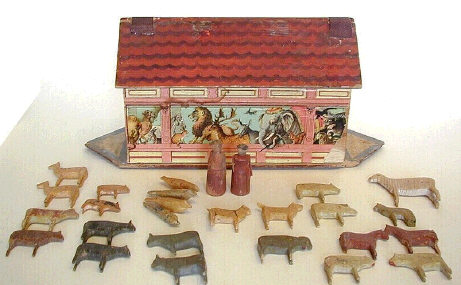
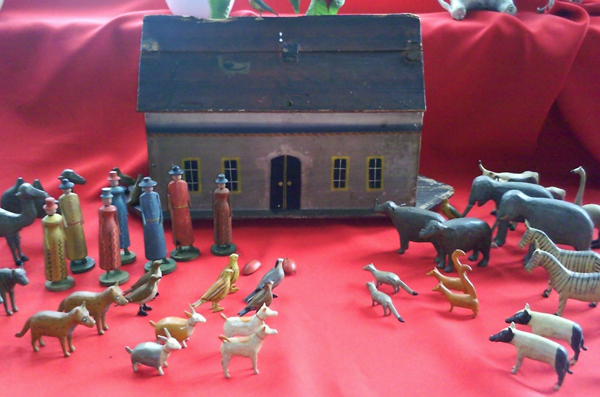
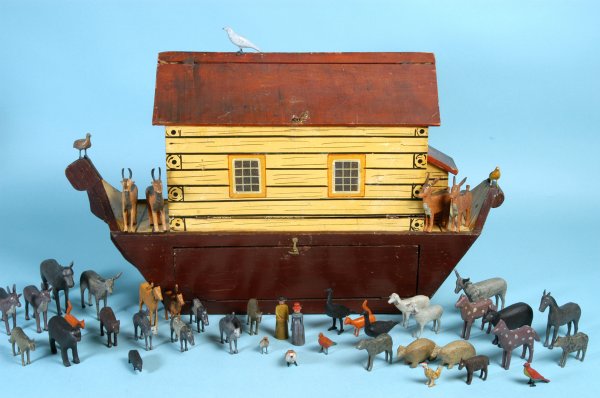
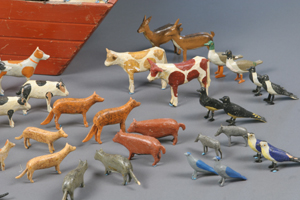
Early Years - Noah's Arks were among the most popular wooden toys of the nineteenth century in Europe and America. Nearly every Victorian family of means had one. Due to their biblical theme, many children were not permitted to play with them except on Sundays. Noah's Arks have been made at least since the 1700s and are being made today but their popularity peaked in the late 19th century. Most arks found from this period were made in Germany or made in America by German immigrants. The ark and animals shown at right form a German wooden, hand crafted set from the late 19th century. Making Animals - Most of the animals in these arks are fanciful. Production in the 19th century was largely a cottage industry. One family may have made only horses while another only monkeys. The family making monkeys had probably never seen a monkey nor did it matter. Some families employed all members of their family making a variety of animals and arks. They were producing toys, not biology teaching tools so their imaginations were reflected in their animals. Green and blue mammals were common (see photo below). The animals shown with the ark shown here are representative of the
ones most commonly The rarest animals are the small ones such as insects and snakes. Also uncommon are animal pairs which have different poses such as one looking and the other feeding. Making Arks -
Arks were made in small factories. Some were made from pieces of wood that
looked like straw and these are sometimes called prisoner arks as though they
were made by prisoners using bedding straw - some probably were. Early arks had removable
roofs into which the animals were stored. These loose tops were easily lost so
hinges were later added. A dove was usually
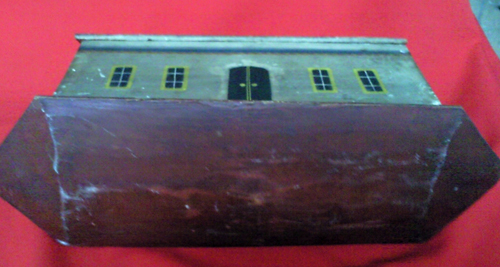
Arks styles generally break down into flat bottoms, rounded bottoms, and boat bottoms.
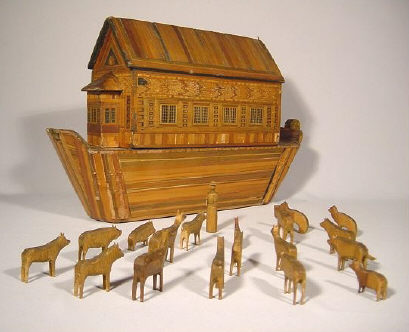
Boat Bottom Arks - The boat bottom ark, shown here, was the most elaborate and costly to produce and is the most valued by collectors.
|
||||||||||||||||||||||
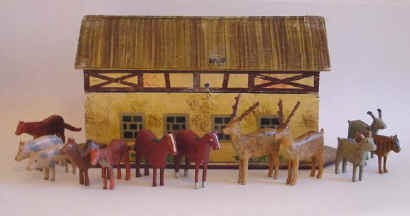
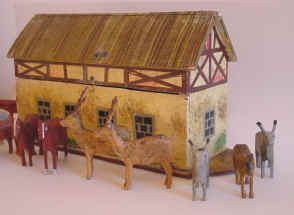
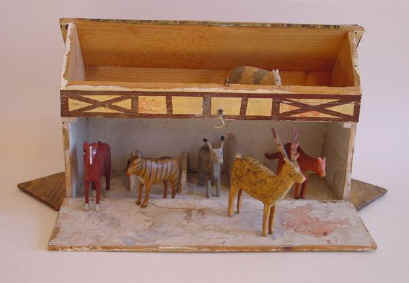
Flat Bottom Arks - A cute example of a flat bottom ark is shown here. This ark was likely made in the late 19th century, or early in the 20th century, probably in the Erzgebirge region of Germany . The original owners of this toy ark were among a very large group of German settlers who came to settle in South Australia in the mid 1800's to escape religious persecution. Beautiful lithographs on this one.
|
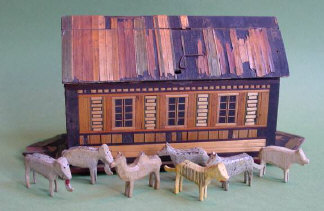
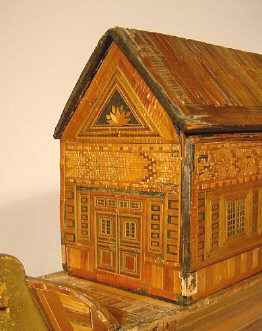
Straw Arks - The most finely made arks are those made from straw and individual sticks and veneers of wood. These strips were often stained to give a beautiful multicolored effect. These arks are usually called straw arks as it looks as though the ark is made entirely of straw. Sometimes the "straw" is woven. These are beautiful arks but the straw pieces have a tendency to break off.
|
Manufacturers - It is virtually impossible to identify ark manufacturers since it was largely a cottage industry. It is also hard to determine what the full complement of animals for a set was. You would think that the number of persons would always be eight since that was the size of Noah's family but I don't think that was always the case. Occasionally, a list of contents is found in a toy catalog or with an ark. The Erzgebirge Toy Museum of
Seiffen - this museum has a very interesting
internet site devoted to toys made in the Erzgebirge mountain region of Germany, where,
for over 300 years, toys like the Noah's Arks shown here were made. See their
site at by clicking on their logo:
Valuation - Noah's Arks have become very popular with toy collectors. The most desirable are the German made, 19th century arks. The boat bottom arks are much more desirable than the flat bottom ones. The taller the better. Originality is very important although most arks have had, or need, some restoration. Their wood parts shrink over time and separations occur. This is a sign of age. Hand painting details increase value. Small amounts of lithographed decoration that enhances beauty is desirable. Arks with all lithographed decoration are not usually as desirable. The more animal pairs the better - single animals don't add very much since finding a matching mate is very improbable - but it does happen. Nice examples sell for thousands of dollars. Particularly spectacular sets have sold for $80,000 or more.
Auction Alert! At Northeast Auctions' August 5-6, 2000 auction of Americana, a Noah's Ark with about 200 animals and about 12 figures of Noah's family reached $28,750! The ark size was 12 inches by 23 inches. The ark was a flat bottomed version. To see a B/W image of this ark, click here. Your Ark - Send
me photos of your old arks and I will publish them. Go to our gallery of
beautiful arks here:
|
| |||||||||||||||||||
 . They were first shaped on a
lathe. A piece of wood was turned into a donut shape with its surface the shape
of the animal to be made. The donut is then sawed or hand cut radially to separate the
individual animals. The animals thus have a slight wedge shape seen from above. The separated,
roughly shaped animals were then hand shaped, and painted. Some families only did
carving while others only painting.
. They were first shaped on a
lathe. A piece of wood was turned into a donut shape with its surface the shape
of the animal to be made. The donut is then sawed or hand cut radially to separate the
individual animals. The animals thus have a slight wedge shape seen from above. The separated,
roughly shaped animals were then hand shaped, and painted. Some families only did
carving while others only painting.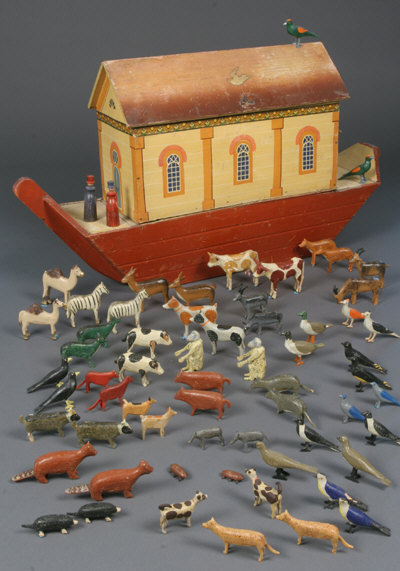 added
to the roof. In about the 1880s, lithography had been well developed and
lithographed decoration began to be added to the arks to save some of the costs of hand
painting. Later, arks were all lithographed. The ark shown here is all hand
painted except for a small strip of lithographed paper near the roof line going
all around the ark.
added
to the roof. In about the 1880s, lithography had been well developed and
lithographed decoration began to be added to the arks to save some of the costs of hand
painting. Later, arks were all lithographed. The ark shown here is all hand
painted except for a small strip of lithographed paper near the roof line going
all around the ark.