All About Old Toys


Punch and Judy
|
A History of the
Punch and Judy Show Photos by Judith Lile and Jim Sneed
|
|||
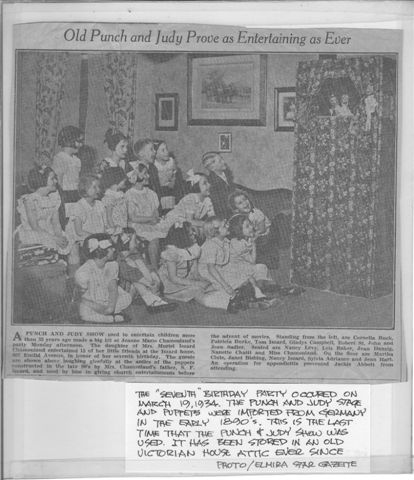
The character of “Punch” made his earliest appearance in the 14th century in Italy, in the Commedia del’Arte dramas, when he was Pulcinella. Later, in France in the 16th century, he became Polichinelle, the “hunchbacked fool of French farce,” and, in 17th century diaries and journals, he is seen in England as Punchinella, Mr. Punch, and finally, Punch. Punch and Judy shows reached their greatest popularity in England in street shows, fairs, and small theatres during the 19th century. Until this time, the often-bawdy shows were directed to adult audiences, but now they had begun attracting more and more children. Toy Punch and Judy shows began to appear. Like other toys, these playthings re-created in small scale the real-life delights of the world in which children lived. Most of the puppets were made in Germany, hand- carved in wood or shaped with papier mache, with exaggerated features and colorful costumes , ranging generally from about 8” to 20” in height. There were usually 6 to 12 figures in a set, though the number varied. Some came with stages, decorated with fancy fabrics and pictures of the performers; others have the name “Guignol” written across the top. Guignol was the name of a mischievous boy puppet created by a dentist in Lyon, France, in the late 18th century. Though this puppet had a button nose and a cute face, he shared Punch’s love of outwitting authority and making sport of it. The word “Guignol” later became synonymous with “puppet.”
It’s easy to see the appeal for children of the Punch and Judy shows – characters of all stripes, silly, nonsensical plots and dialogues, quaint, decorated, little stages. Often a live dog, Toby, sat in front of the stage with a ruff around his neck and a hat on. Punch, furthermore, could commit the most heinous of acts and get away with it! Throw the baby out of the window, whack his wife with a big stick, kill off the authorities that come to take him to jail, chase the ghost away, and, his greatest triumph, vanquish the devil himself, all with a merry grin. Pleased as Punch. There was very little in the way of plot that the street watchers had to follow - Punch must contend with a shrewish wife and a screaming baby so he murders them both and is then forced to defend himself from the law officials and do-gooders who try to get him to the gallows. Whether he succeeds in overcoming them is the suspense of the drama, though the fun is in watching how Punch dispatches them all. The variation in the dramas came from the talent of the puppeteers (called “Professors”) who brought the characters to life with their own humor and skill and sense of the outrageous. The dialogues were passed on orally without much written down, but some authentic texts and scraps do exist. For example, the following is from a performance in 1906, a conversation between Punch and Mr. Jones ( the neighbor, earlier called Scaramouch) about a lost (or found) dog: . Jones. I lost the dog three weeks ago. Punch. I found a dog three weeks ago. Jones. That shows the dog is mine. Punch. No, that shows the dog is mine. Jones. How can the dog be yours when I lost it? Punch. How can the dog be yours when I found it?
Jones.
You found the dog before it was lost. Punch. You lost it before it was found. And here are examples of how some of the dialogue persisted through decades: 1828 Officer of the Law. I’ve come to take you up. Punch. And I’m come to take you down. 1854 I am under the necessity of taking you up. And I am under the necessity of knocking you down. 1856 I’ve a special order in my pocket to take you up. And I’ve a special order to knock you down. 1941 I have come to lock you up. And I’ve come to knock you down. Traditionally, Punch shouts out a victory cry upon disposing of his opponents. In later years, it has been “That’s the way to do it!,” but earlier cries have been “Huzza! Huzza!” (1828), usually for the devil, “ Root-to-to-to-to-oo-it!,” (1854) “Take that! Get up then and down then.” (1887), and, in 1938, “ Wallop!” Fragments of two quite primitive texts came to me a few years ago along with a puppet set. At the end of one, Punch has a fight with a creature called “Nightgrab,” and comes up with yet another farewell, befitting his birdlike attacker: Punch. What are you thinking about you nasty snappy beast? Do you think I am something to eat? I will kill you. (Hits the animal on the head) Nightgrab. (cries) Tweet, Tweet, Tweeeeeeet! Punch. (hits the animal dead) We do not want creatures like you in this world. Now that you are very dead, you will be skinned and kept in an art cabinet. (Drags out the animal and sings.) La! La! Ladidum. Da.
="4" cellpadding="8" cellspacing="4" bgcolor="#DBDBDD" bordercolordark="#CC9900" bordercolorlight="#CC9900">
|
|
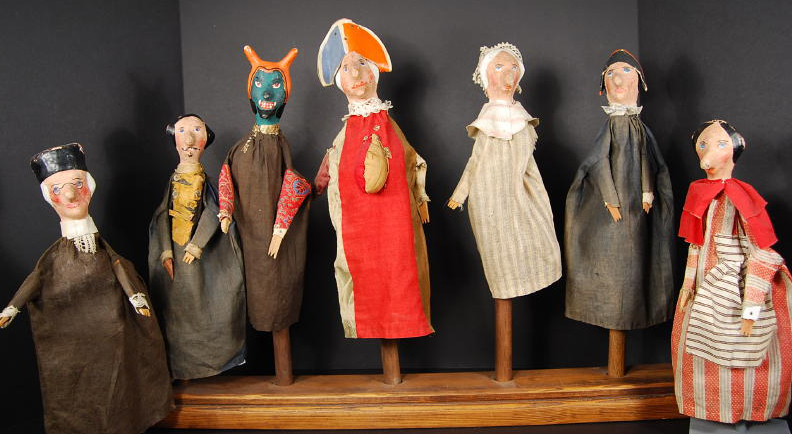
This funny paper mache group has a French look to me, the similarity of Punch's hat to the French flag, the prominent noses, the more delicate details. And it could be quite early: Punch has a hump both in back and in front as some early ones did and there are remnants of Dresden decoration on some of the costumes. They are 13" high, on average. From the left are the Doctor, the Neighbor (?), the Devil, Punch, Judy, the Beadle, and Pretty Polly. |
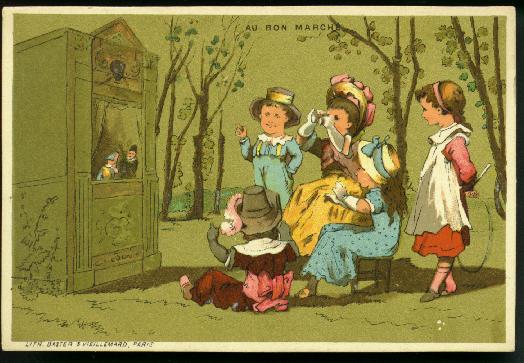

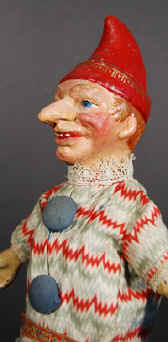
In the English street shows, which are what I’m describing here, there were about 11 stock human characters and 3 animals, who appeared one by one, to bedevil, or be bedeviled by, Punch, who remained always on stage. Punch’s characteristics are deep in the cultures of Europe. In the earliest dramas, he resembled Vice of medieval mystery plays, being both a moral caveat and a buffoon, struggling with the devil, and eventually being carried off to hell by him. Into the mid-18th century this was the expected outcome. Attitudes gradually changed, however, and Punch began to prevail over the devil, often carting him off to the fiery furnace in a wheelbarrow, much to the delight of the street audiences and the disapproval of more proper folk .The landlady in Tom Jones (1749) laments, “I remember when puppet shows were made of good scripture stories….and when wicked people were carried away by the devil.” Punch had a vast belly and a hunchback (as did some court jesters) and wore a high hat, ruff around the neck, big buttons, and colorful suit. His nose and chin were described by some as almost meeting.
An unusual feature that has
continued in some form even to today, is Punch’s voice, which was
produced through a device called a “swazzle”
or “swatchel.”
The Professors wore this circular ring sort of instrument in
their mouths so that Punch always had a squeaking or high whistling
sound to his voice. The
exact origins of the swazzle are unknown,
but the sounds were compared to the Castrati
of 17th c. Italian opera and other 17th c. puppet
shows in which the puppets spoke in squeaking, unearthly, tones.
The Professors
refused to give up the secret of the swazzle,
and only recently has information been published.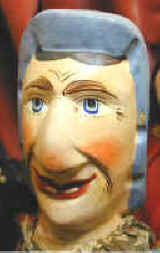
The embattled Judy, Punch’s wife, was his equal in feature, scorn and violence. After being derided, as usual, by Punch, she answers,
Punch, Punch, Punch, prythee think of your hunch,
Prythee look at your great strutting belly;
Sirrah, if you dare
War with me to declare,
I will beat your fat guts to a jelly.
Judy’s name was originally Joan, a common, popular name in the 16th and 17th centuries and the reason for the change is unclear. Judy was a slang term for a “tramp’s woman,” and may have seemed more fitting for the raucous, risque street shows. The last documented use of Joan was in 1818, at about the same time that the puppets went from marionettes to glove or hand puppets. Judy almost always wears a bonnet or a Georgian mob-cap. She comes on stage to bicker and fight with Punch, bring him the baby, and later come back to find the baby gone, berate Punch, and be beaten (to death, I fear) by his stick.
She returns, however, as the Ghost,
to taunt and terrify Punch, who, nevertheless, finally overpowers it.
The ghost was a popular character in the 19th c., but
dropped out of most plays in the 20th .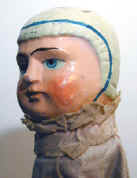
The Baby was added to the cast in the early 19th c. when the changeover to hand puppets occurred. The Professor now could hold Punch in his right hand, Judy in his left, and enable each to hold an object. Judy could carry the baby, and Punch, his stick. These three became the constant of every show.
The Doctor was a regular
visitor to the scene --sometimes when Punch had fallen off a horse (an
on-stage hobby horse), sometimes when he’d been overcome with fright
from Judy’s ghost. I’ll
quote from George Speaight, “
Punch usually pretends he is dead---and says so!
Eventually the Doctor always decides that Punch is shamming and
produces his physic---a stick… In the end Punch always gives the
Doctor a dose of his own medicine.”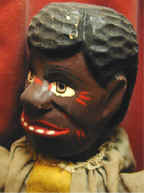
From 1825 to 1942, a black man, or the Negro, has appeared in the shows. At first he was a servant who was sent by his master to tell Punch to stop ringing a bell, which gives Punch an opportunity, of course, for verbal funny business and knock-about. The Negro was also sometimes a foreigner with a bristling beard who would say only “Shallaballa.” In the 1850’s, with the popularity of the song, “Jim Crow,” the negro became known as a minstrel, or Jim Crow. He’s seldom if ever seen today.
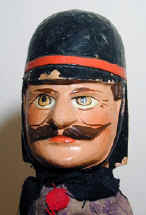
The Beadle is basic to the show. He’s the one who must come to arrest Punch for all the murders he commits. He’s also known as the constable or the policeman, and often there are 2 characters who have this role.
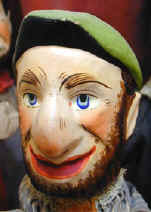
After all the action, Punch is taken away by the Hangman to be hanged. The dying speech was a much- relished part of executions in 19th c. England, and Punch, too, was obliged to repeat, shamefully, the words that the Hangman dictates:
Hangman. I have been a very bad and wicked man.
Punch. I want a slice of bread and jam.
When the moment arrives, Punch
pretends he can’t understand how to put his head into the noose, and,
when the hangman shows him, Punch pulls the noose upward and hangs the
hangman. During this time,
there was a well-known executioner named Jack Ketch and the hangman was
usually known by this name.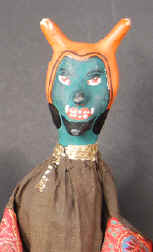
The Devil, as noted, was an essential part of the show from its earliest beginnings. In the 17th century, he came in at the end to bring Punch to his just desserts. But in the mid-18th century, as social feeling was changing, began cheering for Punch to prevail, even against the Devil. A Punch and Judy researcher at the time reports that one “showman, from some scruple or another, refused to allow the victory over the Devil to Punch,” and was “lamentably pelted with mud.” George Speaight writes, “Orthodoxy and justice may have demanded that Punch should suffer for his crimes, but those who know and love him will feel that Punch is, somehow, immortal, and that even the Prince of Darkness cannot touch him.” Later, however, as the morality of the Victorian Age took hold, the Devil’s presence was viewed with suspicion and it was thought that “it was apt to harrow the feelings of the little ones and give them bad dreams.” Today he is seldom seen.
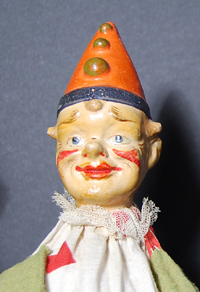
The only member of Punch’s group who doesn’t get killed is the Clown. Known also as Mr. Merryman or Joey, he’s Punch’s companion, his helper, his partner in jokes. Clown’s part in the action is to help Punch dispose of the Hangman’s body, sometimes stuffing him into a coffin.
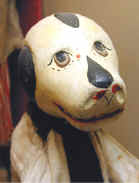
We get much of our information about the puppet shows from drawings, paintings, and prints of the time. Many show the dog, Toby, sitting in front of the stage, or even on it, with his ruff and hat. There are also pictures with monkeys performing along with the dog. One Professor trained his dog to go among the audience with a little basket in his mouth and collect the donations,( the Professors’ only pay ). A Toby might take part in the play, biting Punch’s nose, or similar tricks, but his main function was to add to the attraction and appeal of the performance. Due to the scrutiny of the English SPCA, the live dogs were later replaced by puppets.
Mr. Jones is simply a neighbor, a respectable tradesman, the master of Toby. In earlier days, to at least 1828, he was named Scaramouch. Of course, Punch finds ways to confound and confuse Mr. Jones, shown in the funny, Abbott and Costello exchange above.
Hector and Crocodile are
the 2 remaining basic characters. It was common for the Professor’s
assistant (if he had one) to ride around the fair grounds on a
hobby-horse and stir up interest in the puppet shows.
Hector’s role was to provide Punch
with such a vehicle so that he too could ride around the stage, fall
off, and send for the Doctor. Hector rarely appears after 1850.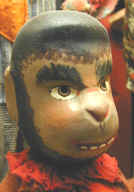
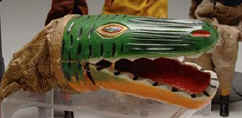
Crocodile has a more
significant part. As the
Devil disappears, the Crocodile arises to take his place.
Usually coming on stage at the end of the play, his battle with
Punch is a fierce, ultimate one. The
hand of the puppeteer inside the long, sharp jaws of the crocodile is
perfectly suited, at the peak of excitement, to snap shut and swallow
Punch’s stick! But
as we all know now, Punch will somehow come through.
The Crocodile is a staple of 20th,21st
c. shows and we should just regard Crocodile as the Devil.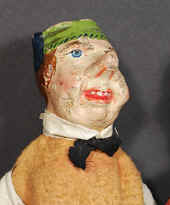
These are the major players. There have been others, such as Pretty Polly, Punch’s mistress in pre-Victorian days, a blind man, Boxers, a monkey, a Chinaman, a Baker—but these have briefly come and gone.
There’s something timeless and universal and, I think, deeply psychological about these shows. We come to love the characters, though there’s nothing admirable or lovable about them. They have funny looks, mean or stupid traits, and invite us to cheer when the bad guy wins. As Speaight puts it,
Why do we laugh? We do not know. This is the mystery of the human soul. Perhaps the spectacle of his fierce assaults releases from our inner consciousness aggressive primitive hidden repressions; and the devils issue out of our lips in gales of laughter. Certain it is that Punch fulfils some deep-seated instinct of human nature, that his little drama has always acted as a cathartic agent upon society.
References
Speaight, George, Punch and Judy, Publishers Plays, Inc., Boston. 1970.
http://www.wikipedia, The Free Encyclopedia