


|
All About Old Toys
|
Rich Toys
Company History
| This history of the Rich Toy Company was provided to me by Bryan M. Rich and Tom Rich, sons of one of the Rich Toys co-founders. No other use of this history is permitted without the permission of Bryan Rich or Tom Rich. |
|
History of Rich Industries,
Inc.
Business
continued to grow and in 1928 the Company moved its operation to Morrison,
Illinois, in order to secure the advantages of larger manufacturing facilities,
a better labor market and additional financing which was necessary to an
expanding business. This company was known as the Rich Manufacturing Company and
was comprised of the two Mr. Rich, Srs., and several business men who were
financially interested only. The Company operated in space rented from the
Illinois Refrigeration Company until October 28, 1929 when a fire started on the
premises of the Illinois Refrigeration Company destroying all the equipment and
inventory of the Rich Manufacturing Company. Unfortunately, the insurance
coverage, which was to be On
April 20, 1932 the Illinois Refrigeration Company ceased operation and sold its
facilities to Rich Manufacturing Company, which took over part of their
personnel as well as the business of the old company. The Rich Manufacturing
Company then changed its name to Rich Illinois Manufacturing Company and began
to make and sell both ice refrigerators and toys. They designed and patented the
first indoor refrigerator, which was subsequently copied by all industry, but
through their increased efforts managed to stay abreast of the market in both
manufacturing and sales, two large trailers were purchased for rolling show
rooms for both the toy and refrigerator lines. This new and novel idea was well
accepted by the trade and contributed to their ability to be competitive. In 1933 they came out with the first knock-down packaged doll house and this item produced a large increase in toy sales. Through their efforts during the period of April 1932 to the fall of 1934, the two Rich Srs. were able to pay back out of profits the $80,000.00 deficit from the previous bankruptcy which their creditors had already written off. Due to economic conditions that existed in 1934, the necessity for additional working capital in the ever expanding business and the demands of the steel industry for cash before delivery to all customers, they were forced to sell the Rich Illinois plant and equipment and to give up the manufacture of ice refrigerators. The building and equipment was sold to a nationally known concern, the City Ice and Fuel Company of St. Louis, Missouri, and the toy business was moved to an abandoned furniture factory in Clinton, Iowa. The business was again operating under extreme adverse conditions, but with an undying determination and progressive sales the two brothers could not be stopped. They were even at this time grooming their boys to take over in future years. Maurice E. Rich, Jr. and Hampton E. Rich stayed out of college that year to help move the plant and Bryan M. Rich and E. M. Rich, Jr. helped after high school and on week ends. Maurice E. Rich, Jr., Hampton E. Rich and Bryan M. Rich being sons of M. E. Rich, Sr., and E. M. Rich Jr. being the son of E. M. Rich,Sr. With the help of local bank financing the elder Rich brothers again began to build an organization. Toy sales increased from year to year and business grew. In 1937 after graduating from high school Bryan M. Rich became a full time employee, having acquired considerable experience in the manufacturing processes during his high school days and vacations. The same year Maurice E. Rich, Jr., having graduated from college and having had considerable experience working in the plant, began with the Company as an industrial engineer. Both Bryan and Maurice have worked at every job concerned with the manufacturing processes as well as all phases of management over the period of years. In 1940 having graduated from college, Hampton E. Rich trained as salesman under E. M. Rich, Sr., but in 1942 was called into active service in the army air force. He was a pilot of a B-24 Liberator bomber and was killed in action October 12, 1943 during a bombing mission over Rabaul Harbor, Southwest Pacific.
|
|
At the beginning of World War II, the Company went into production of gun stocks for use on Springfield type training rifles for both the Army and Navy. In October 1943 the Rich Industries was formed as a partnership, leasing equipment and facilities, and purchasing the inventory of the Rich Manufacturing Company. In the year 1943 in conjunction with the R. C. Bennett Box Company, the Rich Industries expanded its production and added an ammunition box line with a capacity of approximately 4,000, 75 millimeter boxes per eight hour day. Various types of boxes were produced from 1943 to 1945, totaling over one million for the war effort. In 1945 E. M. Rich, Jr., became affiliated with the Company in the Sales Department under the training of his father, E. M. Rich Sr., working out of the New York office for two years. He became well versed in all phases of toy sales, and was promoted to Sales Manager in January 1953. In 1946 Maurice E. Rich Jr., became General Manager and Bryan M. Rich was promoted to Production Manager. In 1948 to 1959 Thomas R. Rich, youngest son of M. E. Rich, Sr., became affiliated with the Company as Purchasing Agent and Cost Accounting. After World War 11 was over, efforts were again put forth for expanding the line of toys. In 1947 Rich Industries brought out the first line of plastic rocking horses. In 1949 we began manufacturing plastic spring suspension hobby horses. Each succeeding year from 1948 to 1952 became more and more profitable. The rocking and spring horse line gave us a large volume in sales, but at the same time our doll house business began to decline in sales due to competition from very cheap lithographed metal doll houses. About this time we became involved in a lawsuit with Wonder Products Company of Collierville, Tennessee. The suit involved an alleged patent infringement on the four spring suspension horse construction on which we were doing such a large volume. Early
in 1953 an intensive survey was made with the thought in mind of relocating our
manufacturing facilities to improve the operation without appreciably increasing
freight cost to our customers. The labor market in the Clinton, Iowa, area had
become very tight and freight rates on raw materials had become a cost factor
because we were shipping in lumber from the West Coast and deep South. After
considering the facilities available from the mid-south area, including
Arkansas, Tennessee, Alabama and Mississippi, we approached the Community
Development Foundation in the city of Tupelo, Mississippi, with our possible
intentions to move to this area. Meetings were held with the local businessmen
and bankers. A series of meetings brought about a proposition from these people
and a B.A.W.I. contract was drawn up, submitted to the Board and was approved
both by the Board and the people in Tupelo, Mississippi. A bond election was
held with an overwhelming majority for the issue. Engineering drawings and
layouts were prepared by Maurice and Bryan with the help of ].M. Thomas, Jr.
After advertising for bids from various contractors, construction began in
October of 1953. Our manufacturing and shipping season was completed in December of 1953 at Clinton, Iowa and Bryan M. Rich supervised dismounting and shipping of all equipment and inventory at the Clinton plant while Maurice E. Rich, Jr. supervised the construction details and receiving of the plant equipment at Tupelo. Temporary offices were set up in the business section of Tupelo and training of office personnel began. We were fortunate in this move in that we were able to bring trained foremen from each department with us from Clinton and with their help Bryan and Maurice began reassembling carloads of the equipment and the factory began its initial operation in late April of 1954. Through the efforts of all concerned , they completed a successful and profitable year. How-ever in 1955 due to pressure by Wonder Products Company on our customers we began to feel a decline in the four spring suspension horse business. Our lawsuit had not yet come to trial and through threats of possible liabilities to our customers and from advise of attorneys not to become entangled in litigation we lost considerable business this year and the succeeding years to follow. Finally in August 1957 a judgment was handed down sustaining the patent in favor of Wonder Products Company. We were able to negotiate agreement with the Wonder Products Company and made a settlement for $10,000.00 damage and allowed to continue the manufacture of the four spring suspension horse on the royalty basis of 10% of the jobber price. This royalty agreement continued through the balance of 1957 and the year of 1958. In the meantime other manufacturer of similar four spring suspension horses continued to manufacture and sell without the 10% penalty at jobber price, which actually represented a 20% additional cost to the customer at the retail level. Naturally with a higher priced item our sales dropped drastically. In 1959, finally realizing the heavy penalty that Wonder Products was imposing on Rich Industries and in view of the fact that they had not yet been able to bring other manufacturers to trial, they reduced their royalty requirements to 5% of the jobber price. This helped a little but even that was not enough to bring the item back to any where near the sales volume previously held. During this time we spent approximately fifty to sixty thousand dollars in attorney fees and settlements. This money could well have gone into our working capital in as much as the Rich Industries has never paid a dividend since it was incorporated in 1947. With the decline in business in 1954, Bryan and Maurice Rich began to scour the market for items other than toys which could be made with the present plant facilities and sold to national and local markets, keeping in mind the availability of raw materials from which these items could be manufactured with a minimum amount of capital expenditure. In 1955 we began to manufacture soft drink boxes during our off-season, and in 1956 we added the production of knock-down wood furniture frames. It was in April of this year that Mr. M. E. Rich, Sr. died at the age of 70 years. After his death M. E. (Maurice) Rich, Ir. and Bryan M. Rich became Vice-Presidents of the corporation. In 1960 Bryan M. Rich was elected Secretary of the corporation. In 1957 it came to our attention that a line of toy guitars, which had been developed by one of the largest guitar manufacturers in the country - the Harmony Company - was available for sale. We negotiated with these people and bought this business at a very minimum Figure. Through this purchase we obtained their stock of raw materials, jigs and fixtures, cost records, a listing of their previous customers and complete know-how to carry the work on. In 1958 we received several contracts for wood ammunition boxes and received our first contract from the Quartermaster Corp to make wood folding tables. In the mean time, through these years we continued to bring out new items in our toy line. We also installed a McBee cost system in order that we would be in a better position to figure cost and selling prices on these new items which we were adding to our line and on which we did not have enough cost information. In 1959 we continued the manufacture of the previously mentioned items, received our second Quartermaster contract for tables, and developed a new spring suspension for our horses on which we have the patent and hope that this will bring back some of our business which we had lost in the past. It has been moderately successful.
During the period from early 1954 through September 1960, the sales of the Rich Industries changed through diversification from 100% toy sales in 1954 to 62% toy sales and 38% diversified sales in 1960. The conscientious efforts of our officers increased our toy sales through new toys, ideas and markets. In addition we sought new ideas and new opportunities in other lines and other fields in an effort to add to our diversified sales line. On April 11, 1962 the Rich Industries Plant suffered a severe flood which put it completely out of operation. Four feet of water in four minutes. THIS WAS THE DEMISE OF RICH INDUSTRIES!!
|
 In
1922 they branched into custom winter auto tops and stock auto enclosures for
Ford, Chevrolet and most popular cars. Business grew and larger quarters were
leased in the manufacturing section of Sterling. Here they expanded the auto
enclosure business. In 1923 when the auto industry started manufacturing sedans,
business in this line began to drop off and the line was supplemented with a
line of wall kitchen cabinets and folding kitchen
step stools. In the fall of 1923 they began to develop a line known as Rich
Toys, which consisted of small items such as pull toys, novelty canes, racing
cars, milk wagons, etc. Carl W. Mott was hired as a designer. He designed wire
components and some special machinery for the manufacturing of products.
In
1922 they branched into custom winter auto tops and stock auto enclosures for
Ford, Chevrolet and most popular cars. Business grew and larger quarters were
leased in the manufacturing section of Sterling. Here they expanded the auto
enclosure business. In 1923 when the auto industry started manufacturing sedans,
business in this line began to drop off and the line was supplemented with a
line of wall kitchen cabinets and folding kitchen
step stools. In the fall of 1923 they began to develop a line known as Rich
Toys, which consisted of small items such as pull toys, novelty canes, racing
cars, milk wagons, etc. Carl W. Mott was hired as a designer. He designed wire
components and some special machinery for the manufacturing of products.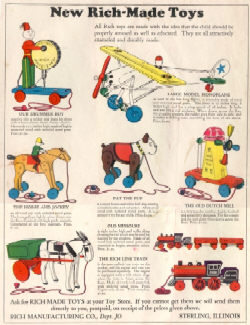 increased the day after the fire, was not sufficient to cover the loss and the
Company was forced into bankruptcy. Creditors were paid with all available
funds, leaving a deficit of $80,000.00. An arrangement was made with the
Illinois Refrigeration Company to use part of the undamaged building facilities
and machinery to continue the production of toys for the next two years.
increased the day after the fire, was not sufficient to cover the loss and the
Company was forced into bankruptcy. Creditors were paid with all available
funds, leaving a deficit of $80,000.00. An arrangement was made with the
Illinois Refrigeration Company to use part of the undamaged building facilities
and machinery to continue the production of toys for the next two years. In
1960 we added a line of water skis on which we had moderate success for the
first year. During this year we developed a line of boat paddles to be sold
along with our water skis being brought out in 1961. We increased our water ski
line to more nearly conform to the price ranges desired by the customers. In
addition we received our third successive wood folding table contract from the
Quartermaster Corp. We also went into production of wood lamp bases for the
Lawrin Lamp Company of Kosciusko, Mississippi, who only this year moved their
plant facilities from Chicago to Kosciusko. It was in October of this year,
1960, that Mr. E. M. Rich, Sr. died at the age of 73. At his death his son E. M.
(Ted) Rich, Jr. became President of the corporation.
In
1960 we added a line of water skis on which we had moderate success for the
first year. During this year we developed a line of boat paddles to be sold
along with our water skis being brought out in 1961. We increased our water ski
line to more nearly conform to the price ranges desired by the customers. In
addition we received our third successive wood folding table contract from the
Quartermaster Corp. We also went into production of wood lamp bases for the
Lawrin Lamp Company of Kosciusko, Mississippi, who only this year moved their
plant facilities from Chicago to Kosciusko. It was in October of this year,
1960, that Mr. E. M. Rich, Sr. died at the age of 73. At his death his son E. M.
(Ted) Rich, Jr. became President of the corporation.