All About Old Toys
















|
|
Guillow
Article by
Dave Pecota
|
The Paul K Guillow Company “They don’t make them like they used to” ... an often heard lament about most everything produced today, including toys. But there is a notable exception in the RTF glider world … the Paul K Guillow Co. Many of the Guillow gliders and ROGs you can buy today look amazingly similar to those made in the 1950’s. Not too surprising when you consider that some of the company’s balsa cutting and slicing machines are half a century old. Paul Guillow, a WW1 naval aviator, founded the original business in the city of Wakefield (MA) in 1926, with a line of balsa shelf model kits of WW1 aircraft. He also wrote several books in the 1930’s and 40’s about model-building techniques. During WW2, the company was forced to substitute cardboard and pine wood for balsa (a strategic material) … with somewhat unsatisfying results. Guillow also produced a series of target drones for the War effort. With the end of hostilities, balsa once again became Guillow’s material of choice for its gliders and kits. Paul Guillow passed away in 1951, and his wife Gertrude took over the reins of the company. By 1953, Guillow introduced its market-changing Jetfire glider … the first packaged with high speed equipment. The Jetfire and other Guillow RTF airplanes were highly successful in the fiercely competitive toy glider market because of their combination of quality, low cost, good flight performance and ability to be easily “trimmed” and modified. These factors have kept Guillow continuously producing a wide range of wood RTF gliders, ROG’s and “stick & tissue” aircraft to this day. (You can find a detailed history of the company and see their entire product line at guillow.com.) |
|
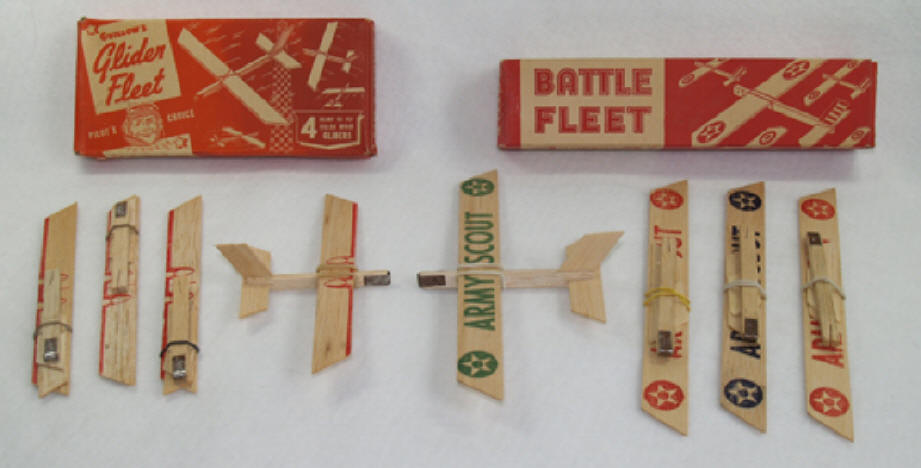
Boxed glider sets (ca 1938-41) – The sets shown here are examples of the several different boxed sets Guillow produced in the immediate pre-War period. The little gliders varied in size and decoration, but the general design was relatively constant. They seem most suitable for flights in light winds or for use indoors, but you got a lot of fun for a nickel! |
|
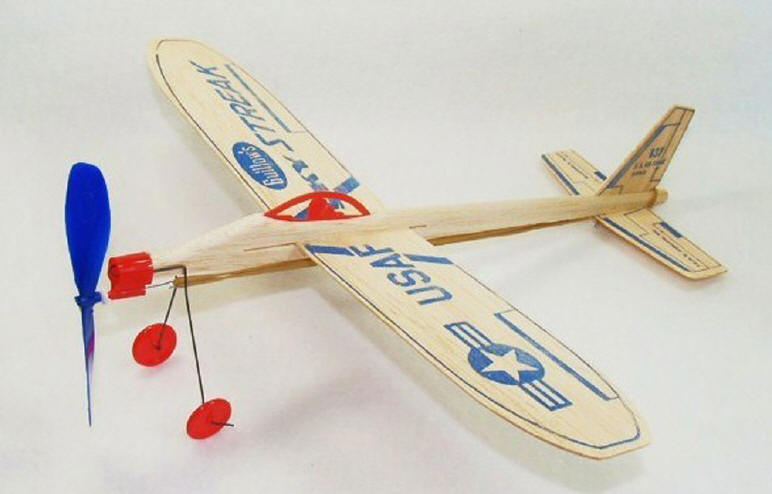
“Sky Streak” ROG (ca 1940’s) – Although the Sky Streak has been in continuous production for many decades, it has undergone some rather dramatic design changes during its long lifetime. The example pictured here may be the first iteration of the Streak. Note the metal prop hanger, tiny wooden wheels and top-of-fuselage location for the rubber “motor”. One hopes it flew better than it looked. |
|
“Sky Streak” ROG (ca 1950’s) – By the 1950’s, the Streak had a more advanced (dare I say, “handsome”?) design. The sculptural streamlined fuselage, plastic prop hanger and larger wheels gave it a more balanced and purposeful appearance. With the aid of both airfoil and significant dihedral on the wings, this “new” Streak was also a good performer. Today’s Sky Streak no longer carries the “ROG” moniker … it no longer has landing gear & wheels that would enable it to “rise off ground”. |
|
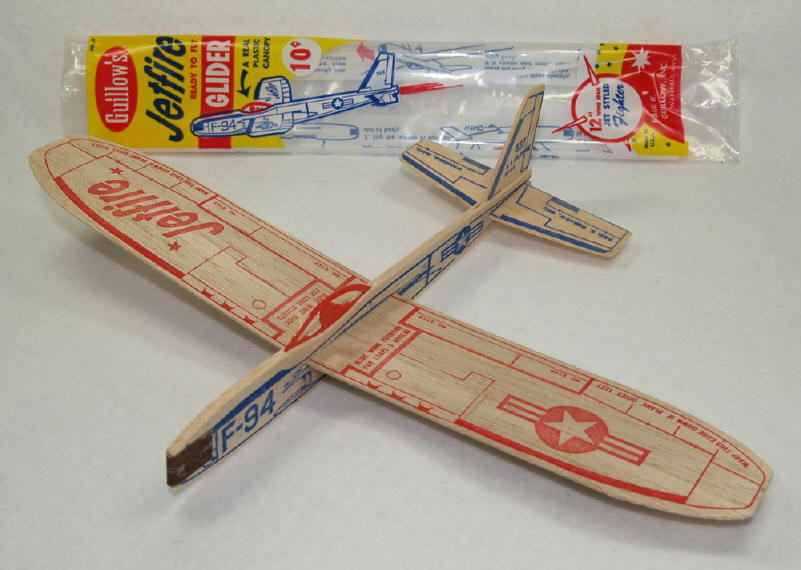
“Jetfire” toss glider (ca 1953-55) – Credited with being the first mass-produced RTF glider packaged with high-speed machinery, the Jetfire changed the marketplace cost paradigm for toy gliders almost overnight. This glider was the basis for most of my flying experiments as a youth. Luckily, they were durable enough to survive most of my “research”. (Only one of my hybrids out-flew the standard plane. But that one “magical” long-winged, V-tailed hybrid out-flew everything I EVER bought!) The Jetfire is still made much the same way as it was half a century ago. |
|
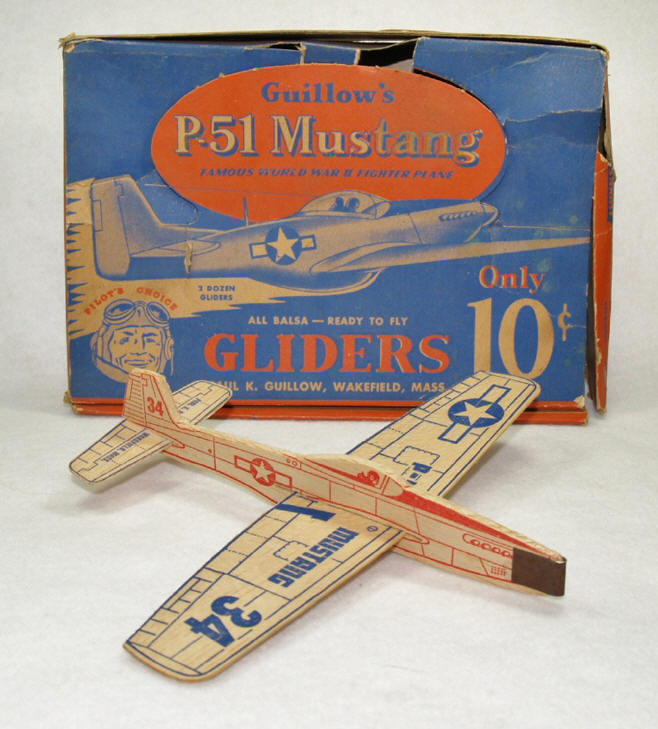
“P-51 Mustang” (ca 1940’s) – Somewhat of a cross between a toss glider and a shelf model, the P-51 is an attractive balsa rendition of the famous WW2 fighter. (Was the large “34” printed on the wing an homage to the AJ 74 glider … or a subtle attempt to inject a little marketplace confusion?) |
|
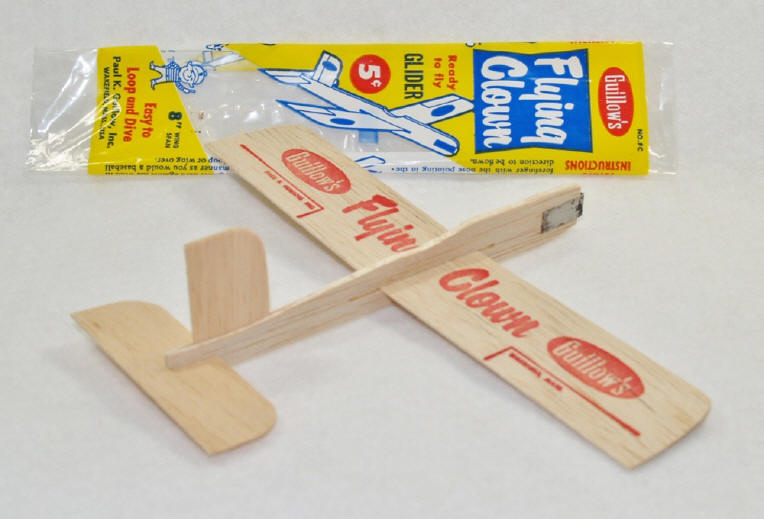
“Flying Clown” toss glider (ca 1960-63) – I consider this diminutive glider to be the chameleon of the Guillow product line. In its 50+ years of production, it has only seen minor changes. But it’s been sold under several names including Flying Clown, Super Ace and Eagle … and under many guises in its role as a promotional item for countless companies and government organizations. This little fellow offers a lot of flying fun for very little money. |